
Operating at 98.5% RTP with stakes from £0.01 to £100 and a maximum win of £10,000, Tower Rush sits squarely in the crash and mines category where timing trumps luck. The game rewards calculated risk-taking and punishes hesitation in equal measure, making it a compelling choice for players who prefer active decision-making over passive spins. Here's everything you need to know before placing your first bet.
Tower Rush: key facts
| Provider | Galaxsys |
|---|---|
| Type | Crash/Building game |
| RTP | 98.5% |
| Volatility | High |
| Min / max bet | £0.01 – £100 |
| Max win | £10,000 |
| Mobile | Yes |
| Demo | Yes |
A taut, high-RTP crash game that hands control to the player and delivers genuine tension with every floor placement.
What is Tower Rush?
Tower Rush belongs to the crash game family, a genre where multipliers climb in real time and players choose the exact moment to cash out before an unpredictable collapse ends the round. Unlike traditional slots that spin and settle, crash games demand active participation: you watch your potential win grow, weigh the risk of pushing higher, and press the button to secure profit before disaster strikes. Galaxsys has wrapped this core mechanic in a vertical building theme, replacing abstract multiplier curves with a tower that rises floor by floor.
Each round begins with a bet and an empty tower. As you place floors, the multiplier increases according to a fixed progression structure. The tower can collapse at any moment, determined by provably fair algorithms that set the failure point in advance but reveal it only as the round unfolds. Your task is straightforward: climb as high as you dare, then cash out before the inevitable crash. The 98.5% RTP figure sits well above most slots, reflecting the binary nature of crash games where the house edge remains consistent but outcomes swing wildly between total loss and substantial profit.
Tower Rush distinguishes itself through bonus floors that appear randomly during climbs. Frozen Floor locks your accumulated winnings temporarily, Temple Floor offers enhanced multipliers, and Triple Build accelerates progression by stacking three levels at once. These features inject variability into what might otherwise become a predictable ascent, though the core tension—will the next floor hold or collapse?—remains the game's defining characteristic. The interface displays your current floor, active multiplier, and cashout button with clarity, keeping the focus on decision-making rather than navigating cluttered graphics.
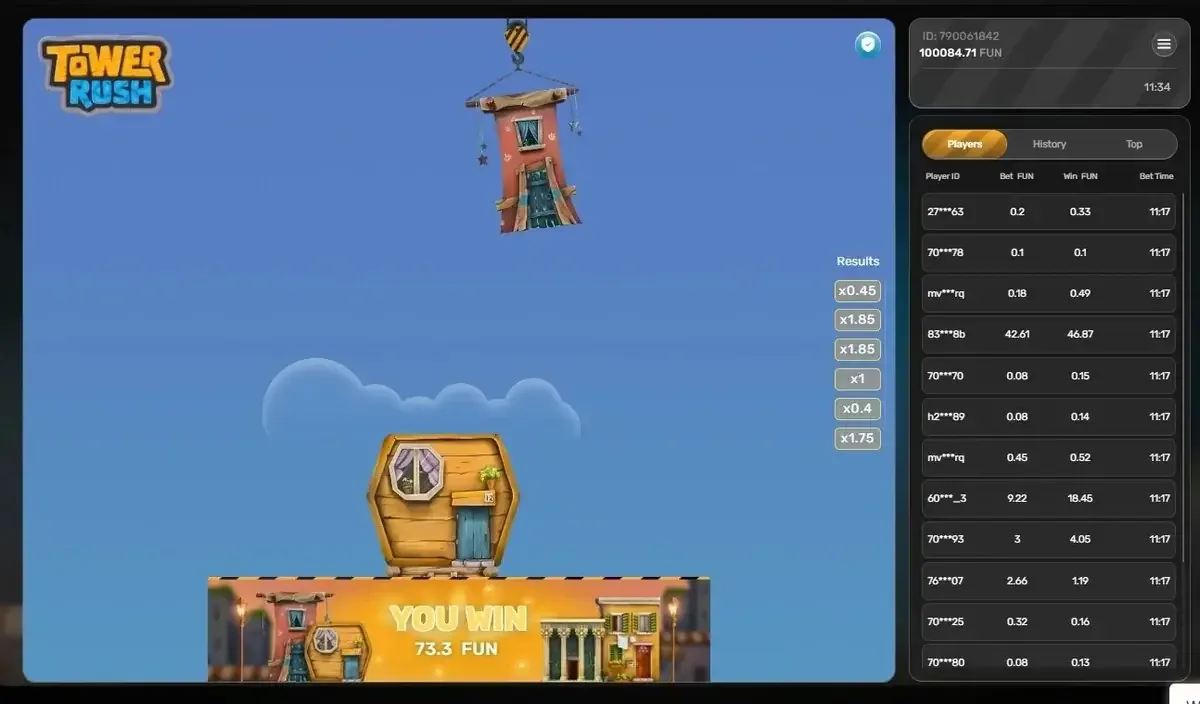
How to play Tower Rush
1: Set your stake and initiate the climb
Select your bet amount using the stake controls, which accept wagers from £0.01 to £100 per round. The chosen sum determines your base risk and maximum potential return—higher stakes amplify both profit and loss in direct proportion. Once satisfied with your bet, press the start button to begin placing floors. The tower appears empty, and your initial multiplier displays at ground level. If you plan to test strategies across multiple rounds, configure auto-bet settings to repeat your chosen stake automatically, though manual control offers greater flexibility when adapting to bonus floor triggers or adjusting risk tolerance mid-session.
2: Place floors and watch the multiplier compound
Each successfully placed floor advances your position and increases the multiplier according to the game's payout structure. Early floors deliver modest gains—think x1.1 to x1.5 territory—while upper levels accelerate sharply, with the highest tiers offering multipliers that can turn a £10 bet into several hundred pounds. The tower visual updates in real time, showing your current floor, the multiplier applied to your stake, and the accumulated win amount. Bonus floors appear at random: Frozen Floor prevents your winnings from dropping for a set period, Temple Floor boosts the multiplier for that level, and Triple Build lets you skip ahead by three floors instantly. These bonuses add tactical wrinkles, but the fundamental risk remains—any floor can trigger collapse, erasing all progress since your last cashout.
3: Cash out before collapse or lose everything
The cashout button activates after your first successful floor placement and remains available throughout your climb. Press it to transfer your accumulated winnings to your balance immediately, ending the round and securing profit. Wait too long, and the tower collapses without warning, reducing your potential payout to zero. The game uses provably fair technology, meaning the collapse point is determined before the round starts and can be verified after the fact, but you cannot predict when it will occur during play. Auto-cashout functionality lets you set a target multiplier—say, x5 or x20—so the system exits automatically when that threshold is reached, removing emotional hesitation from the equation. Manual cashout rewards quick reflexes and risk appetite; automated exits enforce discipline and consistency.
How much can you win in Tower Rush?
The maximum win sits at £10,000, achieved by reaching the game's highest multiplier and cashing out before collapse. Given the £100 maximum stake, that ceiling translates to a peak multiplier of x100, though the exact floor progression and how bonus modes factor into that calculation depend on the specific round and random bonus triggers. The 98.5% RTP means the game returns £98.50 for every £100 wagered over the long run, a figure that ranks among the highest in the online casino space and reflects the mechanical simplicity of crash games compared to feature-laden slots.
Practical win potential varies dramatically based on how aggressively you climb. Conservative players who cash out at low multipliers—x2 to x5—secure frequent small profits but sacrifice the exponential returns available in higher floors. Aggressive climbers who push toward x50 or beyond face longer losing streaks punctuated by occasional massive wins. The volatility is high, meaning bankroll swings are sharp and sudden. A £10 bet cashed at x3 yields £30; the same stake held to x50 returns £500, but the collapse probability increases with every floor. Bonus floors can accelerate progress and inflate multipliers beyond the base structure, but they do not alter the fundamental risk-reward balance.
Key payout dynamics include:
- Early floors (x1.1 to x2): Low reward, high success rate, suitable for bankroll preservation and frequent small wins.
- Mid-range floors (x3 to x10): Balanced risk-reward, where moderate climbs generate respectable returns without excessive exposure.
- Upper floors (x10 to x100): Exponential multipliers with steep collapse risk, reserved for players with deep bankrolls and tolerance for volatility.
- Bonus modes: Frozen Floor protects accumulated wins temporarily, Temple Floor boosts active multipliers, Triple Build leaps three levels at once—all add upside but cannot prevent eventual collapse.
- Maximum payout cap: £10,000 ceiling applies regardless of stake or multiplier, so high rollers approaching that limit should adjust bets to maximise effective returns.
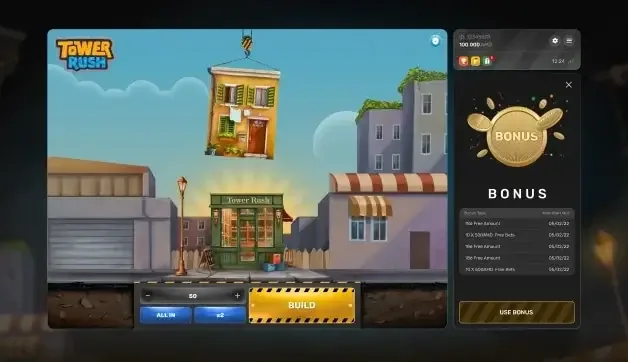
Strategies and practical habits
Define cashout thresholds before you start
Decide in advance at which multiplier you will exit, then enforce that rule across multiple rounds. Whether you target x3, x10, or x50, having a predetermined exit point removes in-the-moment emotional pressure that leads to chasing losses or holding too long. Use auto-cashout to execute this plan mechanically, especially during extended sessions where fatigue erodes discipline. Test different thresholds in demo mode to identify which multiplier range suits your bankroll size and risk tolerance, then apply that consistently when playing for real money. Conservative targets generate steady small profits; ambitious targets produce infrequent large wins and frequent total losses.
Adjust stake size to match volatility
Tower Rush delivers high volatility by design, meaning long losing streaks are inevitable even with a 98.5% RTP. Size your bets so that ten to twenty consecutive losses do not deplete your session bankroll, allowing you to weather dry spells and remain in the game when a successful high-multiplier climb finally lands. A £100 bankroll with £10 bets offers only ten attempts; the same bankroll with £2 bets extends to fifty rounds, dramatically increasing the probability of hitting a profitable climb before funds run out. Higher stakes amplify wins and losses equally, so scale your wagers to your total capital and accept that preserving longevity often matters more than chasing maximum single-round returns.
Treat bonus floors as tactical opportunities, not guarantees
Frozen Floor, Temple Floor, and Triple Build add value when they appear, but their random nature means you cannot rely on them to rescue losing runs or compensate for poor cashout timing. When a bonus floor triggers, consider whether it justifies pushing one or two levels higher than your usual exit point, but do not abandon your core strategy entirely. Triple Build can vault you into high-multiplier territory quickly, but it also places you closer to the collapse threshold—use the accelerated climb to reach your target faster, then cash out as planned rather than letting greed override preparation. Bonus modes are variance enhancers, not edge-reducers; the house advantage remains constant.
Free demo or real money?
Tower Rush offers a demo mode that mirrors real-money play in every respect except payout. The demo uses the same RTP, floor progression, bonus triggers, and collapse mechanics, making it a legitimate testing ground for strategies and cashout thresholds. Use demo play to familiarise yourself with the game's pacing, identify comfortable multiplier targets, and observe how frequently bonus floors appear. Track how often you would have won or lost under different cashout scenarios, then apply those lessons when transitioning to real stakes. The demo does not require registration or deposit, so there is no barrier to extended practice sessions.
Real-money play introduces psychological pressure absent from demo mode. Watching actual funds climb and risking genuine loss sharpens decision-making in ways that play money cannot replicate. Hesitation costs profit; greed costs everything. Start with minimum stakes when moving from demo to real play, allowing yourself to adjust to the emotional dimension without risking significant capital. Once comfortable with the mechanics and your chosen strategy, scale up gradually. The 98.5% RTP applies equally to demo and real modes, but variance means short-term results can deviate wildly from the theoretical average—accept that losing sessions are part of the structure, even with optimal play.
Our verdict on Tower Rush
Tower Rush executes the crash game formula with precision and transparency. The 98.5% RTP is genuinely competitive, the provably fair system provides verifiable randomness, and the player-controlled cashout mechanic delivers the agency that slots inherently lack. Galaxsys has avoided overcomplicating the experience with unnecessary features, keeping the focus on the core tension between risk and reward. The bonus floors add tactical variety without muddying the central decision: climb higher or bank your profit. The interface is clean, the pacing is brisk, and the mobile version performs identically to desktop, making this a solid choice for players who want active involvement in their gambling outcomes.
That said, Tower Rush is not forgiving. High volatility ensures that most rounds end in total loss, and the binary outcome structure—win everything or lose everything—demands strict bankroll management and emotional discipline. Players accustomed to the frequent small wins and bonus features of traditional slots may find the experience austere and punishing. The £10,000 maximum win is respectable but not extraordinary, and the £100 stake cap limits high rollers seeking truly massive payouts. The game rewards players who approach it as a test of timing and risk tolerance rather than a vehicle for entertainment or distraction. If you prefer passive spins with regular feedback, Tower Rush will frustrate you. If you want control, transparency, and the chance to prove you can walk away at the right moment, it delivers exactly that.
👍 Pros
- 98.5% RTP ranks among the highest in the crash game category, offering better long-term returns than most slots.
- Player-controlled cashout puts timing and strategy in your hands rather than leaving outcomes to pure chance.
- Provably fair system allows post-round verification of randomness, ensuring transparency and trustworthiness.
- Bonus floors (Frozen, Temple, Triple Build) inject tactical variety without complicating the core mechanics.
- Demo mode replicates real-money play perfectly, enabling genuine strategy testing without financial risk.
👎 Cons
- High volatility produces long losing streaks even with optimal play, demanding substantial bankroll depth.
- Binary outcomes (total loss or significant win) lack the frequent small wins that sustain engagement in traditional slots.
- £10,000 maximum win may feel limiting for players chasing life-changing payouts on high-stake climbs.
Frequently asked questions
What is the RTP of Tower Rush?
Tower Rush operates at 98.5% RTP, meaning the game returns £98.50 for every £100 wagered over the long run. This figure is among the highest in the crash game and slots category, though short-term variance means individual sessions can deviate significantly from the theoretical average.
How does the cashout mechanism work?
After placing your first floor successfully, the cashout button becomes active and remains available throughout your climb. Pressing it transfers your accumulated winnings to your balance immediately and ends the round. You can also set auto-cashout to exit automatically at a predetermined multiplier, removing emotional decision-making from the process.
What are bonus floors and how do they trigger?
Bonus floors appear randomly during climbs and include Frozen Floor (locks accumulated winnings temporarily), Temple Floor (boosts the active multiplier), and Triple Build (advances three floors at once). They cannot be triggered manually and do not alter the underlying collapse probability, but they can accelerate progress and inflate potential payouts when they occur.
Can you play Tower Rush on mobile devices?
Yes, Tower Rush is fully optimised for mobile play and performs identically on smartphones and tablets. The interface adapts to smaller screens without sacrificing functionality, and the cashout button remains easily accessible during climbs. Both demo and real-money modes are available on mobile through partner casinos.
Is Tower Rush provably fair?
Yes, Tower Rush uses provably fair technology, meaning the collapse point for each round is determined before the round starts and can be verified afterwards using cryptographic methods. This ensures the outcome is not manipulated in real time, though it does not change the fact that the house edge remains constant and most rounds will end in loss over time.